
Q&A with Ryan Fewins-Bliss: 15 Years of Policy & Progress
Fifteen years ago, MCAN was one person with a laptop and a conviction that Michigan students deserved better. What followed was a decade and a half of relationship-building, coalition-forging, and policy-shaping that has transformed what’s possible for students and families across the state.
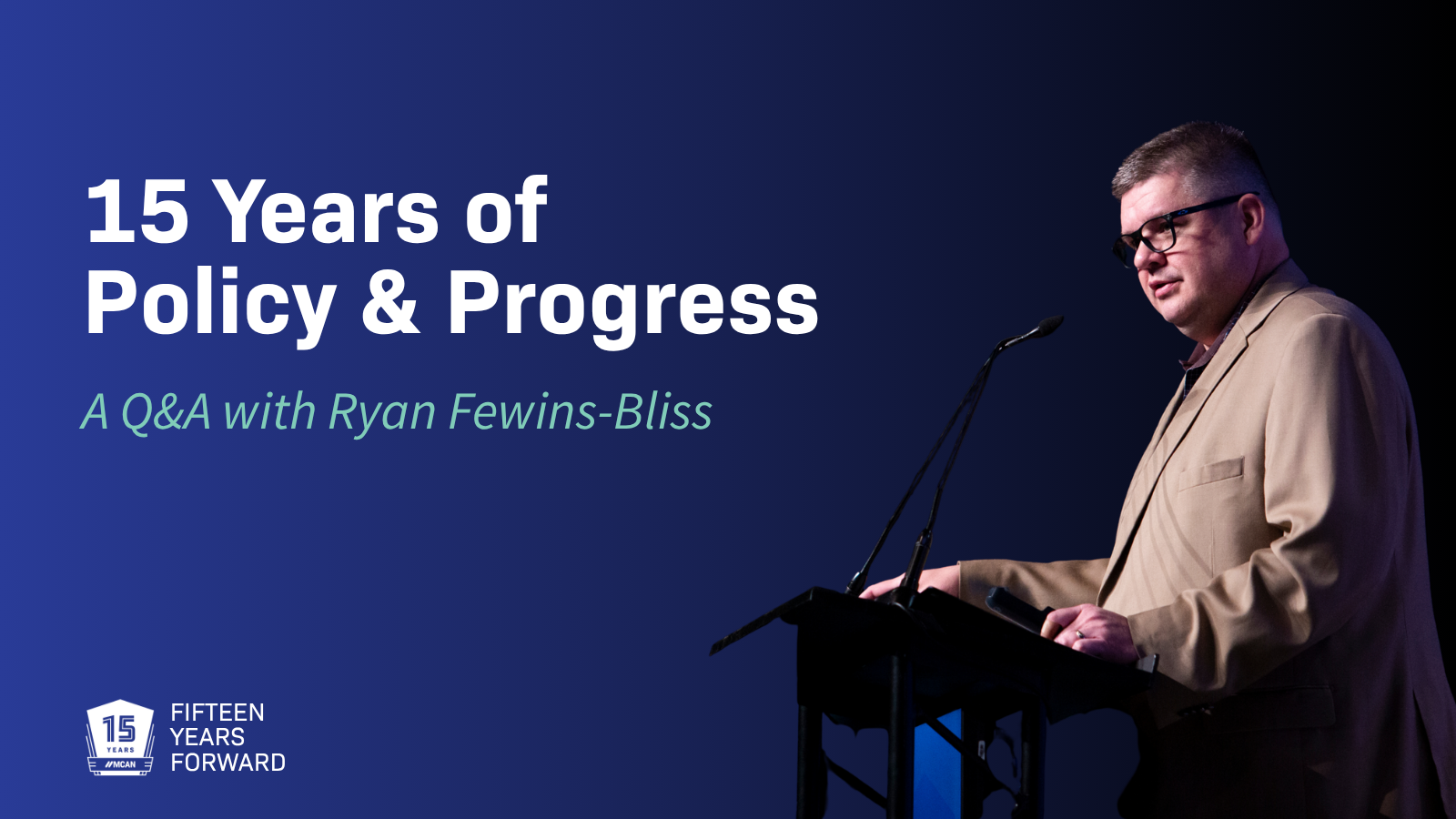
Ryan Fewins-Bliss has been part of that story nearly from the start, working with MCAN as a contractor before joining the staff. A Central Michigan University graduate with roots in K-12, higher education, and community organizing, Ryan — after serving as Assistant and Deputy Director of several MCAN functions — assumed the role of Executive Director in 2019, carrying forward the mission that MCAN’s founder, Brandy Johnson, set in motion. He is, by any measure, a leader who understands both where this work came from and exactly where it needs to go.
As MCAN celebrates its 15th anniversary, we sat down with Ryan to talk about policy — the wins, the work, and what it takes to move a state.
Q: When you reflect on where Michigan was 15 years ago, what were the biggest policy gaps or barriers students were facing? And what do those gaps or barriers look like now?
A: One of the biggest gaps we faced was state-based financial aid in Michigan. At the time, there weren’t a lot of scholarship programs. And sometimes, when scholarship programs were started and promised to students, they were taken away when budgets got bad.
In 2026, we now have $750 million plus more in state-based financial aid. That’s transformative to students, and certainly MCAN played a huge role in that.
Q: MCAN is known for its networked approach. How have partnerships with legislators, state agencies, colleges, K-12 leaders, and community organizations fueled policy progress? How have these partnerships changed over the years?
A: One of the things our founder, Brandy Johnson, did, and I’ve tried to do the same, is build relationships with legislators. At the beginning, we were this thing, this entity that spun out of the Granholm administration. People — legislators, bureaucrats — didn’t know who we were or exactly what we did.
We’ve spent the last 15 years building those relationships, so that I’m texting with legislators every single day. They’re texting us to get our feedback on things. A couple of weeks ago, I was searching for our name in the governor’s proposed state budget. I was looking for something very specific, and I found a whole section that we didn’t even know we were named in. So, while that is somewhat troublesome, it’s actually a huge win, because it means that people are thinking of us and inserting us into laws and the budget to make change in the state without us even having to ask now.
People know that when MCAN is called into the room, you’re going to get the straight answers that are best for students — not necessarily the adults that are working with them.
Q: You’ve talked about wins. What were some of the earliest policy wins MCAN helped advance? What were some of those benchmark wins MCAN was a part of?
A: One of our earliest policy wins was House Bill 4181 in 2017. We needed to address gaps in college preparation, and this bill made that possible. It was an opportunity to better align school counselor expertise with what students actually need.
Since the passing of this bill, we’ve worked with school counselor groups to ensure that their training includes college and career readiness. Before, counselors had to complete training and continuing education, but none of it was specifically geared to career and college access. So, we worked with those school counselor groups to ensure that 50 of their required hours are focused on this issue. This guarantees that every licensed, trained school counselor in every district, in every school building throughout the state, is getting continuous training on this particular issue. And what we found is that they love it. They preferred more training in this area, and so it was a win for everybody.
Q: In your view, what does it mean, or look like, for policy to truly center students, particularly those who have been historically underserved?
A: Sometimes we advocate for policies that our K-12 and higher ed friends, or other partners with shared values, object to. These objections come because it would make their jobs more difficult — school counselors, principals, college advisors, and college presidents would have to do more work. But a lot of times when we’re fighting for those policies, it’s because it makes the students’ and families’ jobs easier. It makes access easier, especially for students of color, low-income students, and first-gen college-going students.
If we want different results in our college access and success movement, and I think we all agree we do, sometimes it means we have to do more and work harder as the adults who are controlling the system. That’s what it means to me to center equity and center students in policy — to make sure the policy is really about them, and not about the adults in the room.
Q: How does MCAN balance bipartisan collaboration while staying firmly committed to equity and student access?
A: A lot of times in our work, people think that equity is a partisan issue, or a partisan term, and what I found at MCAN is that equity means different things to different people. When I go talk to Democrats, I’m talking about education and racial and gender issues. But when I go talk to our Republican friends, I’m talking about geography — rural vs. urban — and students who are getting left behind. Right now in Michigan and across the country, young men are being left behind. That is an equity issue. So, I found that there’s bipartisan support, maybe not in the use of the word “equity,” but in how we carry it out. Our expectation of our legislators is to lead through equity, and I would argue their expectation of us is to make sure we find equitable outcomes for all of those groups of students in our policy and our programming.
Q: While there’s been measurable progress, Michigan has not yet reached the Sixty by 30 goal. What policy priorities feel most urgent in the next four years to reach that goal?
A: To reach our Sixty by 30 goal, we really need to be working with the adult population. The census measures this progress by looking at folks aged 25 and above, not those who are straight out of college, even though they may have a college certificate or degree. So, in order to make the biggest impact right now, using Michigan Reconnect, we need to be building new tools for adults who will be in that age group to best reach our Sixty by 30 goal. That doesn’t mean we’re giving up on access or younger students, because Sixty by 30 is just the beginning. We actually need more like 75% of our residents to have a certificate or a degree to effectively stimulate our economy, so we keep going on the access side every single day.
Q: As MCAN marks 15 years of work, how would you describe the role policy has played in advancing college access and attainment in Michigan?
A: Over the course of MCAN’s 15 years, it’s become really clear that Michigan is, in terms of our higher education system, one of the most decentralized states in the nation. Our colleges are independent. Our schools operate independently. Using policy as a lever is easier in other states where there’s more centralization. So, what we’ve tried to do here in Michigan, at MCAN and our partners, is to build and pass policy that can work in this decentralized system.
These are the levers of power that the legislature and government can shift to get the results they are looking for. They look different from those in other states, but we’ve honed that skill over these 15 years. We’ve figured out what levers we can push and those that we can’t. Then we have to build policy by going high school by high school, school district by school district, or college by college, and individually convince them to come on board. Our state appropriation has been a real gift in that, because we’ve been able to use that funding to incentivize schools, community-based organizations, and colleges by giving them grants to be able to implement policies that they individually have to bring on board because of the decentralized nature.
Q: When you think about the next 15 years of policy and progress, what gives you the most hope?
A: What gives me hope about the next 15 years of policy in Michigan is that we have built an incredible network that is bipartisan, that mixes diversity in all the ways that you can define it. The machine is built, people understand what needs to happen, and we’re willing to come together and make it happen. And that includes our business organizations. That includes our civic organizations. Our philanthropic organizations are so well invested in this. Our governmental levels of power. Our higher ed, our K-12, our community-based organizations. Everyone recognizes the need for talent in Michigan, and while that’s a today issue, it will be a forever issue.
We can’t ever take our foot off the gas in pushing forward on developing talent for the state. I think we learned what happens when we do that. We got ourselves into the problem that we’re in now. And so I think everyone is primed and ready to work together on this issue and not let it falter again. I think that policy will not necessarily be easier in the next 15 years, but I see more common ground and collaboration as a solution.
Q: What has it meant to you to lead policy work during such a transformative period for Michigan students?
A: This time of radical change in college access and success, for the better, has been incredibly personally rewarding. I come from a family that worked very hard, and that helped me get to college. But frankly, I waltzed into college with a lot of privilege. My mom filled out my FAFSA. I didn’t worry about where the bills were going. I sort of arrived there, looked around, and said, “Where are all my high school classmates? Why are they not all in college?” I didn’t even realize the struggle that many students and families go through — but now I do.
Working at MCAN has allowed me to fight for those students who never got there. To fight for those students who should have had a transformative life experience just as I did. An experience that made me who I am as a person and as a leader because I got to go to college. They deserve that just as much as I did.
So, I am proud to be part of this policy sphere, making these changes to make sure everyone can waltz right into college just like I did, have an incredible experience, then leave and change the world and make it better for everybody else who has been left behind.
Q: What are you most proud of?
A: What has made me most proud about MCAN since I have been involved, which is functionally from the beginning, is the level of respect we have developed with our partners, with the field, with funders, with legislators. That MCAN is synonymous with high quality. We will get the job done. We will get it done fast, and we will get it done right, because we know the things that work to get students into and through college. The trust that we’ve built, I just get so proud when a funder comments on an event and how great it was. I have very little to do with most of those things at this point, but our team is so phenomenal. I think the internal pressure we put on ourselves is really healthy to maintain that level of quality and that focus, so that people can trust and rely on what we produce.
What comes through most in talking with Ryan isn't any single policy win or legislative milestone. It's the long view — the understanding that lasting change is built on trust, sustained by relationships, and measured not in budget line items, but in the lives of students who got somewhere they might not have otherwise.
MCAN turns 15 this year. But the work is just getting started.
College still matters. And so does the fight to make sure everyone can get there.